

- Switchboards are similar in function to panels, but on a larger scale.
- A switchboard divides large blocks of electrical current into smaller blocks of current used by electrical devices
- . Applications range from small office buildings, to large industrial or institutional facilities.
- Switchboards are low voltage equipment, 600 volts or less.
- The purpose of a switchboard is to distribute power to loads, disconnect loads for safe maintenance, and to protect conductors and equipment against excessive current due to overloads, short circuits, and ground faults (when ground fault protection is supplied).


- the NEC defines a switchboard as a large single panel, frame, or assembly of panels on which are mounted, on the face or back, or both, overcurrent switches and other protective devices, buses and usually instruments.
- Switchboards are generally accessible from the rear as well as from the front and are not intended to be installed in cabinets. A switchboard is a floor mounted, freestanding piece of equipment.
Components :A switchboard consists of
- a frame,
- bus,
- overcurrent
- protective devices,
- instrumentation,
- exterior covers.
Bus
A bus is a conductor or set of conductors that serves as a common connection for two or more circuits.
Switchboard buses are constructed from metal bus bars which are mounted inside the switchboard to conduct power to various devices.


NEMA Phase Arrangement
Bus bars are required to have phases in sequence so that an installer can have the same fixed-phase arrangement in each termination point in any switchboard. This is established by NEMA (National Electrical Manufacturers Association).


If a non-NEMA phase sequence is used, it must be marked on the switchboard. Unless otherwise marked, it is assumed that bus bars are arranged according to NEMA. The following diagram illustrates accepted NEMA phase arrangements.
Buses are mounted within the frame. Horizontal bus bars are used to distribute power to each switchboard section.

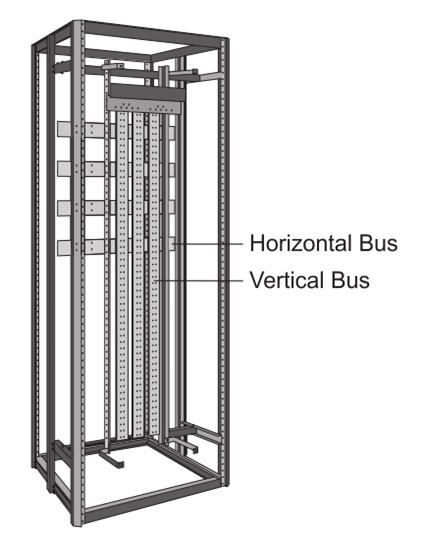
Vertical bus bars are used to distribute power via overcurrent devices to the load devices. Bus bars in Siemens switchboards are made of tin-finished aluminum or silver-finished copper.
Bus bars may either be temperature rated or current density rated. The current density rating specifies the maximum current per square inch of a bus bar cross section.
A bus connector makes a mechanical and electrical connection between a vertical bus bar and its corresponding horizontal bus bar. In this drawing the connector can be clearly seen on the neutral bus.


Compression lugs provided on this switchboard accept properly sized incoming power cables.
Protective Devices
- Protective devices, such as circuit breakers and fusible disconnect switches, are mounted to the vertical bus bars from the front of the unit.
- Other devices installed may include meters, surge protective devices (SPD), utility compartments, transfer switches, transformers, and other equipment.


- There are four types of protective devices commonly used in switchboard applications:
- 1. Power circuit breakers (drawout or fixed mounted)
- 2. Molded case circuit breakers
- 3. Fusible switches
- 4. Bolted pressure switches
Instrumentation Meters
Instrumentation Meters can be used in the incoming section to measure current, voltage, power usages, peak demands, and other important power characteristics.
Enclosures and Exterior Covers


- Enclosures As a standard, switchboards are available in indoor (NEMA 1) and outdoor (NEMA 3R) enclosures.
- Exterior Covers Once the protective devices are installed, exterior cover panels are put in place on the frame. Like the dead front of the panelboard, these covers allow access to the protective devices while sealing off the bus and wiring from accidental contact. The covers also serves as trim for the sake of product appearance.
- A nameplate is attached to the cover panel, providing information on the switchboard type, voltage, amperage ratings, and other manufacturing information.
see also :