

Panelboards are needed to distribute electricity throughout commercial and industrial facilities. A panelboard is a component of an electrical distribution system which divides an electrical power feed into branch circuits, while providing a protective fuse or circuit breaker for each circuit, in a common enclosure. The panelboard serves to protect branch circuits from overloads and short circuits


The National Electrical Code® (NEC®) defines a panelboard as a single panel or group of panel units designed for assembly in the form of a single panel, includinc buses and automatic overcurrent devices, and equipped with or without switches for the control of light, heat, or power circuits; designed to be placed in a cabinet or cutout box placed in or against a wall, partition, or other support; and accessible only from the front.
There are several components to a panelboard:
- Can
- Interior
- Bus Bars
- Circuit protection devices
- Labels
- Cover
- Trim
- Filler plate
Can


- The can, also called the box, is the housing in which the other components reside.
- Typically, it is made of galvanized steel.
- The design of the can provides protection for both personnel and the internal components
- The can’s end panels are removable, allowing the installer to locate and cut holes for conduit installation.
- NEMA has established guidelines for electrical equipment enclosures. Panelboards are supplied as standard in a NEMA Type 1 (indoor) enclosure.
Interiors
Inside the can, you will find the interior consisting of overcurrent protection devices, bus bars, and other components (depending on the application) mounted on support rails. This assembly is commonly called a chassis.


Bus Bars
The centerpiece is the set of bus bars. A bus bar is a conductor, used as a connection point for multiple circuits. Bus bars may he aluminum or copper. They provide a mechanical means of affixing branch circuit breakers. The bus bars are mounted to insulators then on the interior rails, which are mounted to studs in the box.
The neutral bar can he either chassis mounted, or gutter mounted in the can next to the interior. It provides the termination point for the neutral wires from both the incoming service and the load circuits
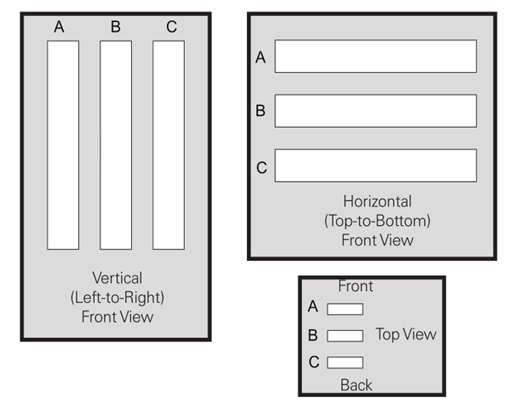
NEC® Article 408 requires three-phase panelboard bus bars to have phases in sequence as shown in the following graphic so that an installer can have the same fixed phase arrangement in each termination point in a panelboard or switchboard.
NEC® Article 408 does provide an exception to this rule, refer to this article for additional details.

Circuit Protection Device
The circuit protection devices are usually circuit breakers. They are connected to the bus bars by bus connector fingers.
Dead Front and Trim
The dead front and trim are the front surfaces of the panelboard that cover the interior. The trim includes an access door.


These components provide access to the overcurrent devices while sealing off the bus bars and internal wiring from contact.
Installation and Mounting
A panelboard can be flush-mounted or surface-mounted against a wall. A flush-mounting is recessed between the wall studs. Surface-mounting is attached to and projects out from the wall.


Flush Mount :
Some panelboards are flush mounted in commercial, office, school, and public buildings. Flush-mounting offers space savings and a more attractive installation.
Surface Mount :
Surface-mounted panelboards are generally used in industrial buildings and in electrical closets and basements of office and commercial buildings. Because some of these areas have walls made of poured concrete, flush-mounting is impractical. Concrete, block, and steel columns may be used for surface mounting.
Common Types
- There are two common types of panelboards:
- Lighting and appliance
- Power
- Lighting and Appliance Lighting and appliance panelboards contain overcurrent protection and means to disconnec lighting, appliances, receptacles, and other small load circuits. The NEC definition for lighting and appliance panelboards has three primary elements: 1. Prior to the adoption of the 2008NEC; a maximum of 42 overcurrent devices (poles) installed in one cabinet. 2. At least 10% of the overcurrent devices must be single pole and rated at 30 amps or less. 3. Neutral connections must be provided.
- Power Power panelboards are generally defined as those that do not fall under the lighting and appliance category. The power panelboard is used to feed other panels, motors, and transformers.
see also :